Friday, 5 September 2014

S4 Parent information - Term 1


Dear Parents/Carers

Please see below some of the key topics your son/daughter will be studying during this term.

If you would like further information on any of the following, please contact the individual teacher at the school.

S4 English – Term 1


They are doing the National 5 course this year. Much of the work is internally assessed over the year and in May 2015, if they have passed the internal tests, they will sit the exam. The breakdown of the final mark is as follows: 30% writing, two pieces done at home/in class over the year and externally marked 40% literature exam, externally marked : (1) a critical essay based on literature read in class - 20% (2) questions on a Scottish set text studied in class - 20% 30% close reading comprehension exam, externally marked Until October we are working at completing the Scottish set text part of the course. We are studying six set poems by Edwin Morgan which they will be examined on for 20% of their final mark. They will be expected to do an hour's homework a week.


S4 Maths – Term 1


Common Factors
Using the distributive law

Factorising

Simplifying

Solving Equations
Evaluating an expression

Calculations in context

 
Number Patterns
Sequences and patterns

Extending number patterns

Well-known sequences
Nth term


Gradient
Gradients in real life

Comparing gradients

Calculating gradients using a coordinate

Grid

Parallel lines

Area and Circumference of Circles
The circle.

Relationship C and D.

Finding the diameter or radius

Calculating area.

Area of kite, parallelogram and trapezium
Area of a parallelogram

Area of a triangle

Area of a kite

Area of a trapezium

Calculating Surface Area
Describing prisms

Nets of prisms

 
Surface area of a prism

Efficient use of materials


S4 Biology – Term 1

Assessment of unit 1 – Cell structure

Multicellular Organisms

Mandatory Course key areas

1 Cells, tissues and organs

Specialisation of cells, in animals and plants, leads to the formation of a variety of tissues and organs.

2 Stem cells and meristems

a. Stem cells in animals can divide and have the potential to become different types of cell. Stem cells are involved in growth and repair.

b. Meristems are the sites of production of non-specialised cells in plants and are the sites for mitosis in a plant. These cells have the potential to become other types of plant cell and they contribute to plant growth.

3 Control and Communication

a. Nervous control Nervous control in animals, including structure and function of central nervous system (CNS) and the brain, to include:

cerebrum, cerebellum and medulla.

b. Rapid reflex action and reflex arc: sensory, relay and motor neurons. Receptors detect sensory input/stimuli. Electrical impulses

carry messages along neurons. A synapse occurs between neurons. Chemicals transfer these messages across synapses.

c. Hormonal control including: Endocrine glands release hormones into the blood stream. Hormones are chemical messengers. Target tissues have cells with receptor proteins for hormones, so only some tissues are affected by specific hormones.

d. Blood glucose regulation including the role of insulin, glucagon, glycogen, pancreas and liver.

S4 Chemistry – Term 1

Assessment of unit 1 – Chemical changes and structure

Nature’s Chemistry
Mandatory Course key areas
Homologous series
The study of cycloalkanes and branched chain alkanes and alkenes (up to C8).To include their physical, chemical properties, general formulae, systematic names, structural formulae, uses, reactions and isomers. Reactions —combustion and addition.
Everyday consumer products
Uses of alcohols and carboxylic acids: to include their physical, chemical properties. For straight chain alcohols and carboxylic acids (C1–C8) general formulae, systematic naming, structural formulae. Functional groups in alcohols, carboxylic acids and esters.Manufacture of esters as a use of alcohols and carboxylic acids and .Uses of esters.
Energy from fuels
Energy calculations involving Eh = cmΔT

(There is no requirement to calculate enthalpy per mole.) Calculations based on balanced equations

S4 French – Term 1


Finish LES ETUDES (Talking about school and your future career)

MA VIE: My Life

  • Relationships with parents, brothers, sisters and friends: how do you get on with your family – What are you allowed and not allowed to do – Household chores.
  • Hobbies – Sports -
  • Health – Advantages of a healthy lifestyle – Dangers of an unhealthy lifestyle
S4 RMPS – Term 1

S4 will study Animism this term.


S4 PSE – Term 1

At the beginning of this new academic year, all secondary pupils will be taking part in discussions which will inform their programme of study for the year. The focus for learning will be around the individual’s mental, emotional, social and physical wellbeing. The programme this term will include work on:


  • Study skills
  • Target setting
  • Reflecting on their own learning and using learning logs as a tool for personal development
  • Social wellbeing and positive thinking

S3/4 Health and Food Technology Term 1

 This term S3/4 will be studying the National 5 unit Food for Health. We have already begun to look at the macronutrients (protein, carbohydrate and fat) and will move on to look in detail at some of the vitamins and minerals required for a healthy balanced diet. We will then begin to consider diet through life; which involves looking at the nutritional requirements of each life stage from babies to the elderly. This theory work will be reinforced with practical experiences that involve producing food to meet specific requirements.

S4 Geography – Term 1


During this Term students will be involved in the study of the following topics:


  • Rural Geography
  • Changes in the rural landscape in developed countries related to modern developments in farming including diversification, impact of new technology, organic farming, genetically modified crops & government policy.
  • Changes in the rural landscape in developing countries related to modern developments in farming such as genetically modified crops, impact of new technology, bio- fuels.
  • National 4 Value Added Unit.
  • Individual Project

S4 History – Term 1


During this Term students will be involved in the study of the following topics:


  • The North Atlantic Slave Trade.
  • Reasons for the growth of the North Atlantic Slave Trade.
  • The Trade Triangle.
  • Slave factories.
  • The Middle Passage.
  • How did the North Atlantic Slave Trade affect Britain?
  • Captives experience & Slave Resistance.


S4 Art – Term 1

S4 will be continuing working on the Expressive Unit of the National 4 course. This includes drawing individual Still Life objects using a variety of media, beginning to create compositions and examining and discussing the work of relevant artists.

Context for learning: Investigating the work of artists including Wayne Thiebaud and Audrey Flack to inspire and inform own artwork.

Approaches to learning: Opportunities to further explore individual areas of interest within Art and Design through taught lessons and independent work. Practical art making informed by and linked to critical work


S3 Parent information - Term 1


Dear Parents/Carers

Please see below some of the key topics your son/daughter will be studying during this term.

If you would like further information on any of the following, please contact the individual teacher at the school.


S3 English – Term 1

They are starting the National 5 course this year. Much of the work is internally assessed over the two year period and in May 2016, if they have passed the internal tests, they will sit the exam. The breakdown of the final mark is as follows: 30% writing, two pieces done at home/in class over the two years and externally marked 40% literature exam, externally marked : (1) a critical essay based on literature read in class - 20% (2) questions on a Scottish set text studied in class - 20% 30% close reading comprehension exam, externally marked Until October we will be doing an intensive novel study, based on John Steinbeck's novel "Of Mice and Men". We will also be working on developing comprehension and writing skills. They will be expected to do an hour's homework a week.

S3 Maths – Term 1 

 
Estimation and rounding: Rounding and accuracy, upper and lower boundaries, effects of rounding, tolerance

Powers and Roots: powers, roots, using a calculator

Scientific Notation very small, very large, using a calculator

Fractions, percentages and decimals: Recurring decimals, equivalences, mental percentages, choosing most suitable method, using a calculator, increase and decrease

Financial Skills 1: credit and debt, credit cards; gross and net pay, income tax

Pythagoras: Right-angled triangles, Pythagoras‟ theorem, calculating size of lengths, converse Pythagoras‟ theorem

Circle 1: circle terms, circumference, diameter, radius calculations

Statistics 1: Reading bar, pie and line graphs Finding Mean Median Mode Range

Proportion: revision of fractions; adding subtracting, multiplying and mixed numbers

proportion:Direct, inverse, graphs and constant

Similar Shapes: congruent shapes, similar triangles areas of similar shapes and scale factors


S3 Biology – Term 1


Cell Biology

Transport across cell membranes
a. The cell membrane consists of lipids and proteins and is selectively permeable.

b. Passive transport is along a concentration gradient and does not require energy.

c. Diffusion in cells as the movement of molecules down a concentration gradient.

d. Osmosis as the movement of water molecules across a membrane in terms of

water concentration.

e. Animal cells can burst or shrink and plant cells can become turgid or plasmolysed in different solutions.

f. Active transport requires energy for membrane proteins to move molecules and ions against the concentration gradient.
Completion of Practical assessment1: Transport across Cell Membranes, Osmosis (National 5)

Completion of Short report assessment2: Transport across Cell Membranes, Osmosis (National 5) „Sports drinks and rehydration‟


S3 Chemistry – Term 1


Chemical Changes and Structure

Mandatory Course key areas
Rates of reaction
Average rate of reaction calculated from graph to show change in rate of reaction as reaction progresses.
Completion of Practical assessment 1: Calculating rates of reaction (National 5)


Atomic structure and bonding related to properties of materials

  • Nuclide notation including: Isotopes and relative atomic mass, Ions, and Ionic bonding.
  • Covalent molecular including: covalent network and ionic lattices.
  • Physical properties of chemicals explained through bonding.
  • Chemical and ionic formulae including: group ions.

S3 Physics – Term 1

Physics will focus on waves and radiation this term, with the hope that the end of topic test will occur just prior to the October break.

 
S3 French – Term 1


LES ETUDES (Talking about school and your future career)

  • Talking about the timetable and your subjects, describing your school and the buildings, talking about the rules and regulations, plans for the future, discussing difficulties at school.
  • Revision of how to say the time in French.
  • Grammar: the Perfect Tense, expressing "since" in French.
  • -ER- verbs, FAIRE & ALLER.
  • Expressing the near-future: ALLER + infinitive.
S3 RMPS – Term 1

This term, S3 pupils will study Christianity.

PSE – Term 1

At the beginning of this new academic year, all secondary pupils will be taking part in discussions which will inform their programme of study for the year. The focus for learning will be around the individual's mental, emotional, social and physical wellbeing. The programme this term will include work on:


  • Study skills
  • Target setting
  • Reflecting on their own learning and using learning logs as a tool for personal development
  • Social wellbeing and positive thinking
S3 Practical Woodworking – Term 1

Flat frame construction.
This will include: measuring, marking out, use of tools and techniques to produce a range of flat frame joints.

Pupils will read drawings to produce a cutting list in preparation for manufacturing a flat frame.

They will also be measuring, marking out, using tools and techniques to produce a flat frame.


Health and Food Technology S3 – Term 1
 
This term S3/4 will be studying the National 5 unit Food for Health. We have already begun to look at the macronutrients (protein, carbohydrate and fat) and will move on to look in detail at some of the vitamins and minerals required for a healthy balanced diet. We will then begin to consider diet through life; which involves looking at the nutritional requirements of each life stage from babies to the elderly. This theory work will be reinforced with practical experiences that involve producing food to meet specific requirements.

Music Term 1

S3 – Scottish Music/Solo Performing
 
 
This term the S3 class will be studying Scottish music at National 4/5 level. The main unit will be Listening and Understanding which aims to enrich the pupil with many concepts relating to Scottish music. These take the form of Melody/Harmony, Rhythm/Tempo, Structure/Texture/Form, Styles and Timbre. There will be an aural test at the end of this unit covering all concepts learned at this level. Pupils will also undertake some composing, and this will usually take the form of writing a Reel, Waltz or Slow Air. Pupils are encouraged to perform their own compositions.

Pupils will also be continuing their studies in Performance. Pupils will regularly practise on two instruments and this will culminate in a performance day where pupils will perform to each other/teachers. They will self-reflect on their performance highlighting areas for improvement together with aspects they thought went well.

S3 Geography– Term 1

During this Term students will be involved in the study of the following topics:


  • Glaciation.
  • Map Skills: basic map skills recap, recognition of glacial features & land uses on O.S maps.
  • Land use conflicts in an upland glacial environment.
  • Coasts.
  • The Scottish Coastline.
  • Waves.
  • Coastal erosion and features of coastal erosion.
  • Coastal deposition and features of coastal deposition.
  • Human activity along the coastline.

S3 History – Term 1


During this Term students will be involved in the study of the following topics:


  • The North Atlantic Slave Trade.
  • Reasons for the growth of the North Atlantic Slave Trade.
  • The Trade Triangle.
  • Slave factories.
  • The Middle Passage.
  • How did the North Atlantic Slave Trade affect Britain?
  • Captives experience & Slave Resistance.


S3 Art – Term 1


S3 will be investigating the built environment and structure of buildings, beginning by drawing and taking photos of interesting details around the school building, using mark making techniques and rubbings to explore textures and materials. Looking at well-known buildings in Orkney including St Magnus Cathedral, Earls and Bishops Palace, Italian Chapel etc.

They will make initial observational sketches both in class and at home to inform a final large-scale painting or series or work. Experimenting with scale and different techniques, to represent buildings, including printing, cut paper collage and ink drawing.

Context for learning: Investigating work of artist John Virtue, focusing on his London paintings. Looking at subject matter, limited colour scheme, media and technique.

Approaches to learning: Active learning, opportunities to work both individually and as part of a group, both taught lessons and independent work. Practical art making informed by and linked to critical work


S1/2 Parent information - Term 1


Dear Parents/Carers

Please see below some of the key topics your son/daughter will be studying during this term.

If you would like further information on any of the following, please contact the individual teacher at the school.


English – Term 1
We will be reading "The True Confessions of Charlotte Doyle" and doing oral and written work based on the novel. Each pupil has the novel. Each pupil also has a copy of "Developing Comprehension Skills" and we will be working from this text too. They will be expected to do 1/2 an hour to an hour's written homework each week.

Maths – Term 1
S1/2 will study the following during Term 1:-
Integers- I can use my understanding of numbers less than zero to solve simple problems in context.

Ratio and Proportion- I can show how quantities that are related can be increased or decreased proportionally and apply this to solve problems in everyday contexts.

Powers and index form- Having explored the notation and vocabulary associated with whole number powers and the advantages of writing numbers in this form, I can evaluate powers of whole numbers mentally or using technology.

Algebra –with introduction to Brackets -Having explored the distributive law in practical contexts, I can simplify, multiply and evaluate simple algebraic terms involving a bracket.

Statistics –Interdisciplinary project with Science- I can display data in a clear way using a suitable scale, by choosing appropriately from an extended range of tables, charts, diagrams and graphs, making effective use of technology.

Mental/ Non Calculator Maths-I can use a variety of methods to solve number problems in familiar contexts, clearly communicating my processes and solutions.


Science –S1/2 - Term 1
S1/2 will study the following during Term 1:-
Electrical circuits- Having measured the current and voltage in series and parallel circuits, I can design a circuit to show the advantages of parallel circuits in an everyday application.

Cells- Using a microscope, I have developed my understanding of the structure and variety of cells and of their functions.

Atoms, Elements and compounds- I have developed my knowledge of the Periodic Table by considering the properties and uses of a variety of elements relative to their positions.

Making and breaking compounds- Having contributed to a variety of practical activities to make and break down compounds, I can describe examples of how the properties of compounds are different from their constituent elements.

Gravity and the university, Are we alone?- By using my Knowledge of our solar system and the basic needs of living things, I can produce a reasoned argument on the likelihood of life existing elsewhere in the universe.

I have collaborated in investigations into the effects of gravity on objects and I can predict what might happen to their weight in different situations on Earth and in space.

French – Term 1

BIENVENUE!- Welcome!

  • Introducing oneself and one’s family.
  • The date (days, months, year, current date + birthdays.
  • Numbers from 1 to 31
  • French alphabet (spelling out names)
  • Classroom objects + classroom general commands & questions (Asseyez-vous s’il-vous plait, Sortez vos livres, etc...)
  • Colours + adjectives (agreement)
  • Nationalities & countries.
  • Use of CDs, teacher and Foreign Language assistant for listening and talking activities. Paired talking exercises. Use of Smart board for various exercises and vocabulary reinforcement. Balance of the 4 skills in most lessons. Research on the "DOM-TOM" (overseas French regions) using ICT skills.
MA VIE – My life
  • Daily routine: Reflexive verbs at the present tense - Verbs in -ER- The time and frequency (Tous les matins, deux fois par semaine, etc…)
  • The French school system.
  • Helping at home: Je fais la vaisselle, Je sors les poubelles, etc…
  • Verb FAIRE at the present tense (Je fais de la plongée, etc… - Giving my opinions about hobbies and clubs.
  • The Conditional (On pourrait + inf.) - Different types of TV programmes

 PSE – S1
At the beginning of this new academic year, all secondary pupils will be taking part in discussions which will inform their programme of study for the year. The focus for learning will be around the individual’s mental, emotional, social and physical wellbeing. The programme this term will include work on:
  • Study skills
  • Target setting
  • Reflecting on their own learning and using learning logs as a tool for personal development
  • Social wellbeing and positive thinking

PSE S2
At the beginning of this new academic year, all secondary pupils will be taking part in discussions which will inform their programme of study for the year. The focus for learning will be around the individual’s mental, emotional, social and physical wellbeing. The programme this term will include work on:

  • Study skills
  • Target setting
  • Reflecting on their own learning and using learning logs as a tool for personal development
  • Social wellbeing and positive thinking

    RME – S1/S2
  • Christianity (Work on the Christianity booklet)
  • Slavery

Craft – Term 1

S1 SKETCHING AND RENDERING
This unit of work will introduce and develop Graphic Communication skills in rendering and sketching.
· S1 PRACTICAL CRAFT SKILLS
Pupils will design and manufacture a Spatula.
· S2 PRACTICAL CRAFT SKILLS
Pupils will design and manufacture A Mug Tree, Shelf unit, etc.
· S2 GRAPHIC COMMUNICATION
This will include a scheme of work to develop Orthographic drawing techniques and skills

Home Economics S1/2 – Term 1
This term S1/2 will be studying Food Hygiene. They will be learning about personal and kitchen hygiene when cooking, food spoilage and contamination as well as food storage and preservation. This will be embedded with practical activities that address some of the issues in the Food Hygiene module.
Music Term 1

S1/2 – Performing/Instruments of the Orchestra
The S1/2 music course this term focuses on performing their chosen instrument, and a listening unit covering Instruments of the Orchestra.

Pupils will be required to document their practice regime, including target setting and goals. Teacher input will come in the form of short discussions with the pupil and help will be given both musically and in goal setting. Although there will be no formal assessment, pupils will be expected to show improvement over the duration of this term.

The listening unit introduces the Instruments of the Orchestra. Pupils will learn about the orchestra and listen to the various families of instruments. By the end of this unit pupils should be able to identify instruments by sound, construction and name. A test will end the unit along with a research project on one of the instruments from the orchestra.


Social Subjects – Geography

S/2 – Term 1

During this Term students will be involved in the study of the following topics:

What is Going on Under the Earth.

  • What is the earth made of?
  • Where do volcanoes and earthquakes occur?
  • What happens at Plate Boundaries?
  • Earthquakes
  • Volcanoes
S1/2 History – Term 1
During this Term students will be involved in the study of the following topics:

  • Europe and the Age of Exploration.
  • Reasons for exploration.
  • Examples and impacts of exploration.
  • Individual Project.
S1/2 Art – Term 1
S1 & S2 will be designing and producing handmade wrapping paper and gift tags. They will look at examples of simple pattern development, symmetrical and non-symmetrical and investigating nature for a basis to build and create their own patterns. They will explore different techniques to produce wrapping paper, both handmade and digital.

Context for learning: Investigating work of designers including Timorous Beasties (contemporary) and William Morris (traditional).

Approaches to learning: Active learning, cooperative/collaborative learning, opportunities to work both individually and as part of a group. Practical art making informed by and linked to critical work.

Monday, 30 June 2014

Bring and buy sale - 22nd May 2014


Here's a short report by the P7 class on the bring and buy sale held at the school a few weeks ago:


"On Thursday 22nd of May Upper Primary had a bring and buy sale to raise money for Ben’s P7 Birsay trip. There were different types of stalls. The stalls were nail painting, sales table, games table, decorate your own cookie and cake stall. We had lots of customers and had great fun. We raised approximately £115. Thank you to everyone that gave a donation and to everyone that came to support us on the day." 

Tuesday, 10 June 2014

AFYD / OTFA Junior Angling Competition

Image
The Kirkwall Grammar pupils may not have been very lucky with the fishing conditions on 29th May, with very modest baskets of trout,  considering what the Kirbister Loch can have to offer on a good day… However, for the second round, on 5th June, the Stronsay Junior High pupils were not much luckier!
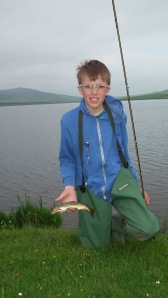
The weather looked promising, with a decent cloud cover and a gentle breeze from the S-E but the high water level made it very difficult for the youngsters fishing on the fly to reach the fish. The boys’ perseverance wasn’t rewarded, as only two fish were caught during the whole competition; Thomas and Ieuan both managed to hook a Kirbister brownie on bait, but which one was the biggest???
The weigh-in, which should have been a short affair with only 2 fish brought to the scales (!)  required a bit more deliberation than expected! Thomas’ fish weighed 5oz 5/8 while Ieuan’s seemed to indicate the same weight until it decided to push the scales to the 5oz ¾ mark!!! And Ieuan was crowned winner of the day! All competitors received prizes generously donated by W S Sinclair, Shearers and Stockans.

Many thanks to Jim Erskine and Andy Rose who assisted the youngsters
Mr P.
Image

The final results of the AFYD / OTFA competition:

Image

AFYD Trout fishing trip to the Mainland

The Stronsay anglers made their annual pilgrimage to the Kirbister Loch on Wed. 4th, Thurs. 5th and Fri. 6th June.
Few fish were caught but they were nicely spread as all the 5 boys managed to hook a Kirbister brownie which tasted lovely on the barbecue on the last day...
Even though the trout were very reluctant to take either bait or fly, there were a few highlights during our trip:

Mat's trout
Matthew1On Day 1, Matthew, who was fishing a little bay on the east shore, hooked his first wild brownie, not only on the fly but with a Bibio which he tied himself during his AFYD lessons at school. No mean feat! In spite of the relentless rain on the Wednesday and the relative lack of activity , Matthew kept working his flies and by the Friday, his casting and retrieving technique had improved drastically!

Robbie, who was on a mission to catch a trout with his grandad's rod and flies, persevered the whole afternoon, through the rain and haar but couldn't quite tempt those finicky little trout! Robbie will definitely have to try again next year!

James also displayed a lot of determination and even though he was rewarded on the last day with a lovely trout (see video), his immaculate casting style deserved a lot more! Not sure what he enjoyed the most however... Was it catching his trout or eating it? ;-)
James
Thomas&JackThomas, Jack and Ieuan kept exploring the shore in search of feeding fish but those must have been in deeper water, possibly feeding on caenis larvae and not showing much interest for bait or wet flies presented in the shallows. However, the three young anglers managed to land a trout or two.
I would like to thank Jim Erskine for his time and expertise, Andy Rose for his enthusiasm and good humour and Derek Smith for keeping a watchful eye on the youngsters during a particularly wet afternoon! I'm also very grateful to Papdale Halls who kindly hosted our group over the three days and the Orkney Trout Fishing Association whose generous financial contribution helped a lot towards the minibus hire.
The last word of thanks, and not the least, is to our youngsters who have not only showed an exemplary behaviour on the trip, but also the right attitude to angling, persevering through the rain, trying different methods, learning from the coaches' experience, always friendly and yet respectful.
Mr P.
(For more photos and other "Troot in the Shed" posts, visit: http://trootintheshed.wordpress.com/)